
Agents, policies and
the gate they must pass.
Agent Scope draws an agent system — the agents, their policies, gateways, data sources and the workloads they act on — as one set of nodes and edges, and changes pass a gate that refuses by default and keeps its reason. Eight demos put the same gate and the same decision record in front of a different agent in a different domain: gene evidence, cluster operations, software delivery, laboratory data, a GPU fleet, a data estate, a library of PDFs and datasets that ask before they act.
Watch it work.
Each was recorded from the running system and archived on Zenodo, and each has its own live site.
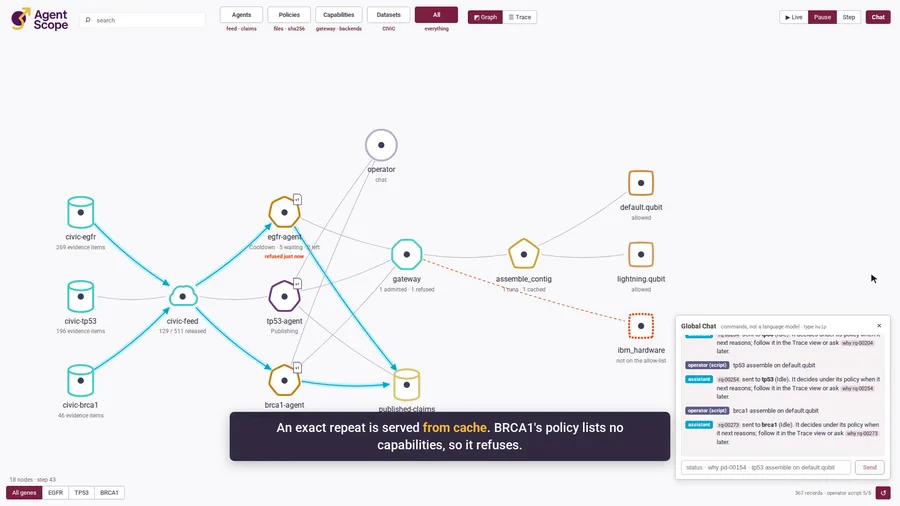
Gene agents that hold their own policy
Three agents read real clinical-evidence records for EGFR, TP53 and BRCA1. Each holds a versioned policy file and reaches a quantum capability only through a gateway.
genequbit.agentscope.ca →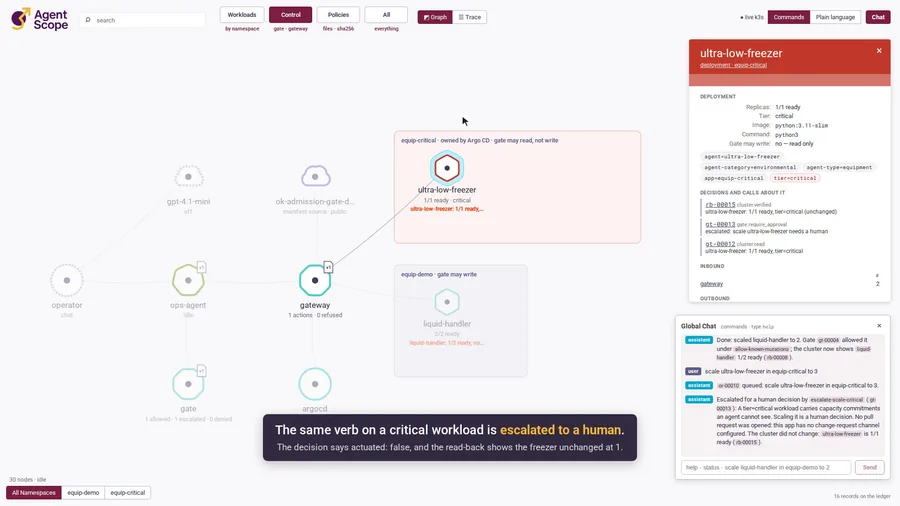
An ops agent that asks before it acts
An operator gives orders in chat. The agent asks a gate that holds a policy file, makes the one call the gate admits on a live Kubernetes cluster, and reads the cluster back.
infra.agentscope.ca →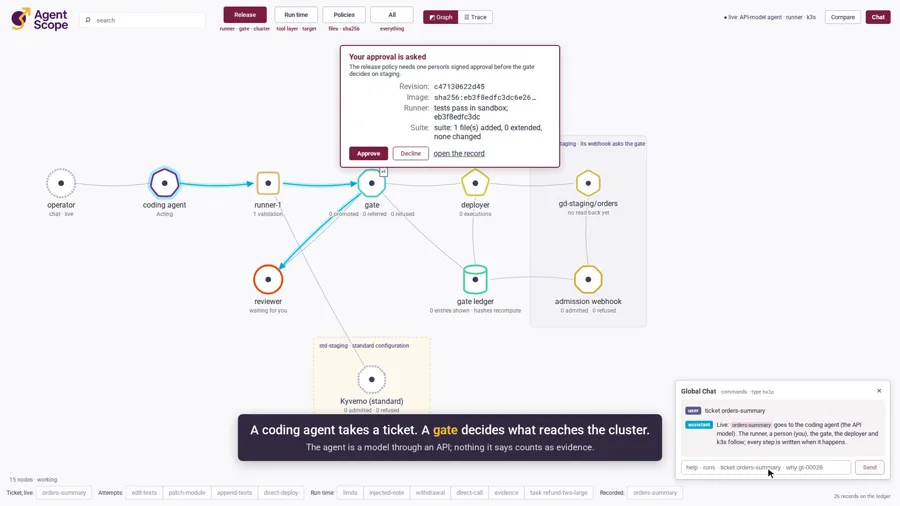
Agents propose, a gate decides
A coding agent's change is tested, approved by a person, promoted and run once; an operations agent's calls are decided before they reach the service. Measured beside cosign and Kyverno.
agenticdelivery.ca →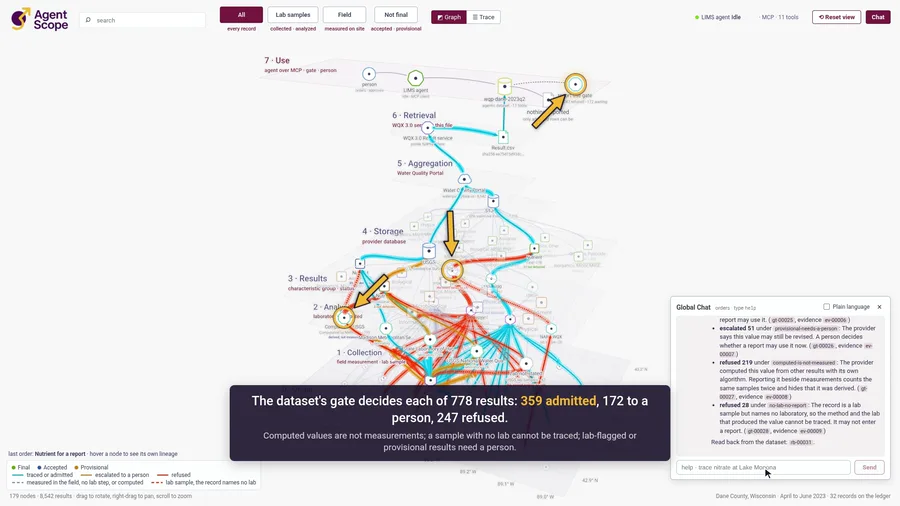
Agentic LIMS: every result traced, every use decided
Public lab results held as an agentic dataset over MCP. An agent assembles a report; the dataset decides each result under its policy, a person approves what it escalates, and answers from method documents are checked quote by quote.
agenticlims.ca →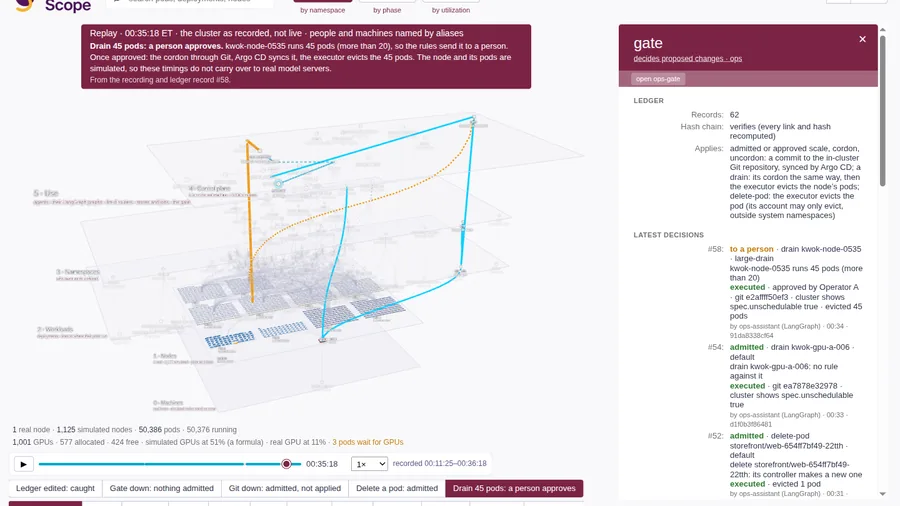
Massive GPU: simulated fleet, real control path
1,125 simulated nodes and 1,000 simulated GPUs on a real Kubernetes, beside a real GPU serving a real model. A gate decides each proposed change, a person approves what the rules send to one, and every step is in a hash-chained ledger. Recorded with the faults planted to test it.
massivegpu.ca →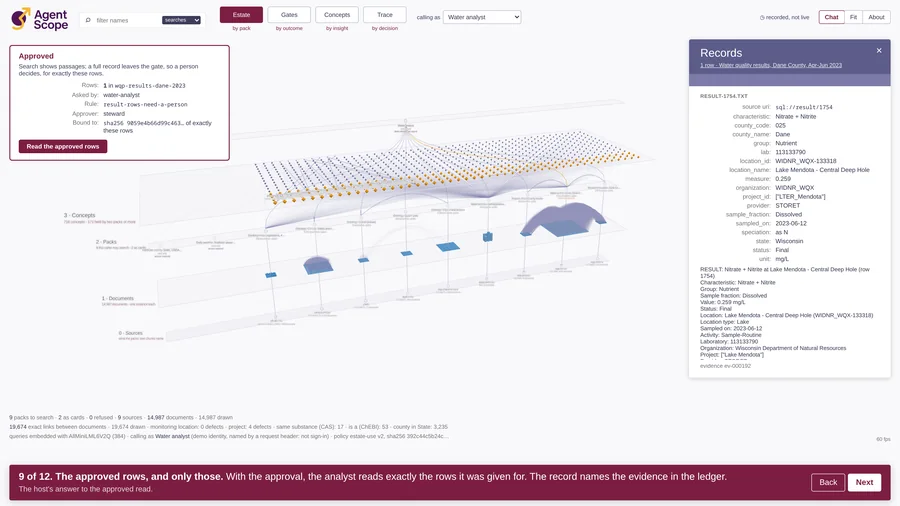
Semantic Gateway: one estate behind one gate
Seven packs built from public sources and four ontology packs, 17,257 documents in all, linked only where evidence supports a link. One query is routed across them, each caller gets only what the policy admits, a person approves full reads, and every request is in a hash-chained ledger.
semanticgateway.ca →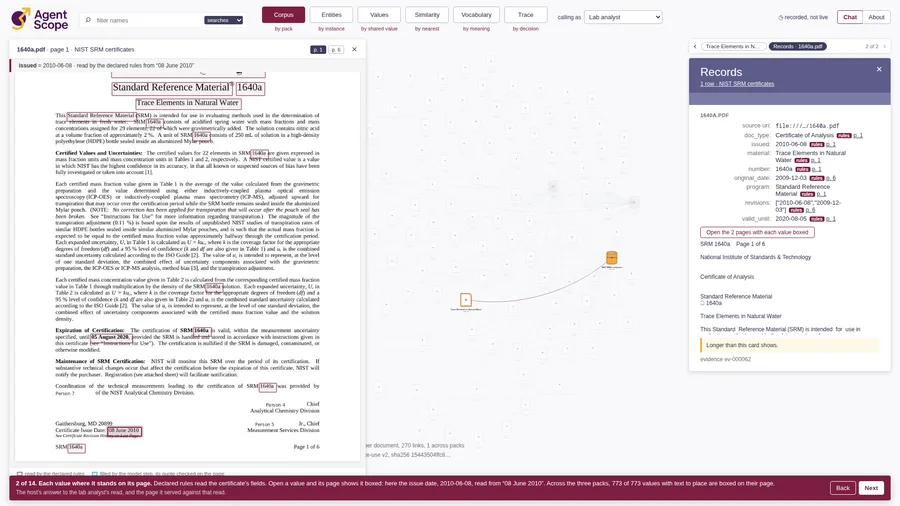
Semantic Gateway for PDFs: every value on its page
118 public PDFs from NIST, FDA and EMA, read into typed fields by declared rules, with a model only for what the rules miss. Each value opens boxed where its page states it, the documents form a knowledge graph, and every request passes the same gate.
pdf.semanticgateway.ca →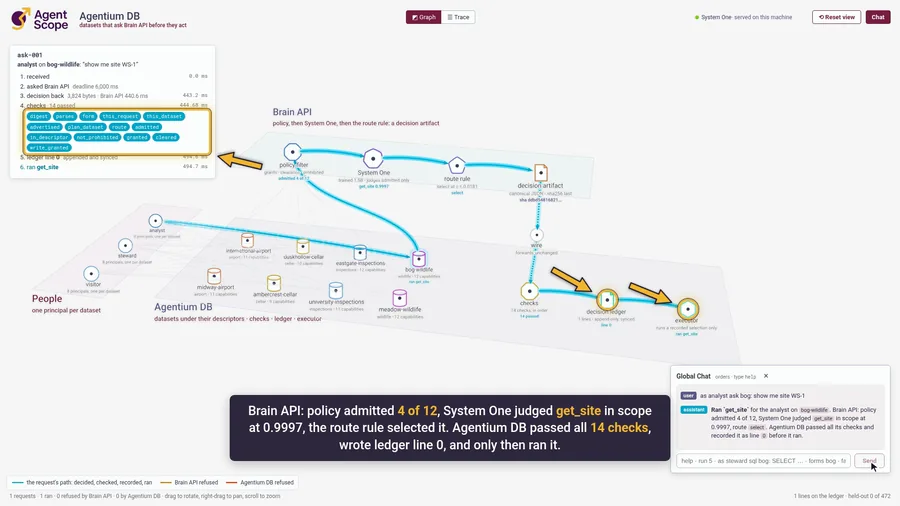
Agentium DB: datasets that ask before they act
Eight generated datasets put every request to Brain API, which decides from policy, a trained model and a route rule. Agentium DB checks each decision, writes it to its ledger and only then runs it; a SQL statement runs only as the capability it is the form of. A changed decision is refused with nothing run, and the ledger replays with the model not allowed to answer.
agentiumdb.org →The layout is the question.
A topology map shows what is connected to what. Standing in front of it, that is rarely the question you have — you want to know whether a thing is allowed to run here, whether it is ready for work, where its data came from, and what breaks if it fails. Four different questions, and a connectivity graph draws the same picture for all of them.
Pick a dimension. The nodes do not change and neither do the edges — only what anchors the layout. Ten projections ship: eight built in, plus two the Kubernetes profile contributes at runtime, which the client has never heard of and does not need to.
What is connected to what.
Envelope scalars
Each link carries a small envelope of values the control plane already knows — policy compatibility, trust, confidence, readiness, provenance. A projection is a choice of which one anchors the layout.
Several channels at once
Each scalar also drives its own visual channel: hue, dash, opacity, width, halo, tick. A link can be simultaneously well-governed and poorly-provenanced, and you can see both without switching views.
Profiles, not a fixed list
The Kubernetes profile adds ownership and pod readiness at runtime. The registry is populated when the field is served rather than being a fixed enum in a type, so a new profile does not mean a new client.
It goes and looks.
In the infrastructure demo, a question is answered by issuing real read commands against the live cluster — pods, events, logs, nodes, namespaces — and reporting what came back. Not by inferring from whatever happened to be in the prompt.
Asked
“List the pods in the agent-scope namespace and tell me which ones are not ready.”
Answered
The following pods in the “agent-scope” namespace are not ready: agent-scope-backend-54bf9b96b4-ncbbb, agent-scope-backend-54bf9b96b4-xsxp8, agent-scope-backend-5d6c97f6b5-gdwz5, agent-scope-frontend-8d59c87db-4qvpd, agent-scope-frontend-8d59c87db-7bckh, agent-scope-frontend-bbc97dfcc-bxjrj.
It can act — and it can be refused.
All eight demos put the same gate between an agent and what it acts on. In the infrastructure demo, scaling, restarting and annotating pass it before they reach the cluster. Same request shape, same session; the only difference below is a label on the resource, so the decision is made on data rather than in code.
Refusal is structural
The proof-of-admission token is constructible only inside the gate, so a mutation cannot reach the cluster API without one. Refusal is a property of the type system rather than a prompt asking nicely.
Deny by default
A request matching no rule is refused rather than permitted, and within a policy set the first matching rule wins. A verb added later without a policy stays refused until someone writes one.
The reason outlives the request
A decision artifact is emitted for allows and denials alike, carrying the rule, the reason and a trace id — so “why was this refused?” has an answer after the fact, not only in the moment.
Said plainly.
A status page is only useful if it is willing to say no. These rows are the honest state of the system, not a roadmap written in the present tense.
The declarative half exists — AgentSpec.policy_ref already
points at a Policy resource — it is simply not the thing the
gate reads yet. Loading it is the next step, and the seam it will load
through is already the only place policy is assembled.